Blog ESM
Train accident in Spain (Santiago)
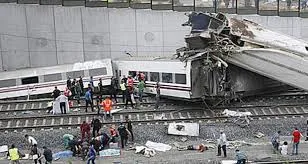
Everybody is careless.
There is a difference between “being careless” and “fallible”, therefore there is a great difference between the actions arising from one state or another. The first committed “follies”, the second “error”. Everyone makes mistakes, but ¿did all we careless?
Francisco José Garzón, the train driver of Alvia Madrid-Ferrol derailed in Santiago, could make a mistake, but then to show that there was recklessness there is big distance. Francisco Jose had worked as a railway 30 years, 10 as a train driver. It would have gone through that route many times. Therefore, in order to prove he was reckless must rely on facts and not opinions. For example, would you know how many sanctions or reprimands had for making unwise behavior at work, or if he decided to run away without help victims after the accident, like Captain Schettino of the Costa Concordia.
A person does not become reckless without saying anything about the overnight. Did he have 10 years being reckless? Had been reckless over 50 times what would have happened on that stretch? Prudence Judging by the number of reckless acts, we should divide a hypothetical reckless behavior by the number of prudent conduct of his professional life, getting out a positive balance in favor of prudence with a lot of difference.
Another issue very different is human errors or failures. This is discussed from two perspectives, the purely cognitive psychology studies: Why do humans make mistakes and under what circumstances? And from the perspective of safety management, namely, management of human reliability and how this from envisaged European safety regulations.
If we confuse “reckless” with “mistakes” then we are all reckless. The recklessness connotes character, personality disorder tends to be consistent and permanent in time. Furthermore, recklessness is spelled out in the Criminal Code incriminating. The “human error” Cognitive Psychology addresses them for many years and has to do with “information processing” and the complexity of human behavior. There is much literature on this precisely because we do make mistakes absolutely everyone.
Human errors can be of different types and are always the result of something: have causes and which are based on these causal factors are classified in one way or another in order to prevent and set limits (Reason, J. Human Error 1990). Not the same error of knowledge that a slip, a transgression of routine or situational, and not the same because the sources of error are well different. The first thing to do is to know the origin of each type of error and know what factors had on the environment so that there is the possibility thereof.
Would then need to know the probability that in this scenario, with these factors, possible commit that error and if any individual could have committed. Perform this error classification task requires some expertise and research methods handle human error (HRA Human Reliability Assessment). These methods and models that support them have international benchmarks and are now applied in sectors such as aviation or maritime.
What would be true is that there was imprudent not to conduct a rigorous scientific analysis and simply to apply adjectives with wrong connotations, it is unknown whether intentionally by those who are doing it or is just pure ignorance.
* Pilar Calvo is a psychologist, has over eighteen years working in Human Reliability in ESM and author of the book ‘The Human and Organizational Factors in Railway Accidents Research’
Continuar leyendo
Artículos relacionados
Factores Humanos
Los errores humanos no son causas, son consecuencias
Es muy interesante este Estudio que subraya el aumento de los accidentes marítimos en el mundo, es también preocupante que el inmenso avance tecnológico…
Leer artículo
Factores Humanos
Más que amigos!
Desde hace años venimos trabajando con el método CRM (crew resource management) y con el BRM (bridge resource management) en el sector aéreo y marítimo…
Leer artículo
accidente de tren
20 años del Ladbroke Grove
Se cumplen 20 años del accidente de Ladbroke Grove (Paddinton 1999) donde una colisión frontal entre dos trenes de pasajeros, uno de los cuales era de…
Leer artículo